As an Amazon Associate, we earn from qualifying purchases. Some links on this site are affiliate links at no extra cost to you. Our recommendations are based on thorough research and editorial judgment.


How Smart Device Detection Works in Qi Chargers

Smart device detection in Qi chargers guarantees ideal power transfer by identifying compatible devices through a two-phase process. First, the Analog Ping Phase sends test pulses to recognize potential receivers. Next, the Digital Ping Phase facilitates communication, confirming device compatibility. Additionally, safety features like Foreign Object Detection (FOD) prevent overheating and protect against incompatible materials. Overall, this sophisticated technology enhances user experience and charging efficiency, paving the way for advanced developments in wireless power innovation.
Key Takeaways
- Qi chargers initiate an Analog Ping Phase with test pulses to identify compatible devices before charging starts.
- The Digital Ping Phase communicates longer signals to confirm device compatibility and adjust power levels accordingly.
- Smart chips continuously monitor the charging process, ensuring safety and efficiency through effective load modulation.
- Foreign Object Detection (FOD) mechanisms prevent potential overheating hazards by identifying and reacting to metallic objects.
- Advanced algorithms adaptively optimize power delivery based on real-time device communication and environmental factors.
The Importance of Device Detection in Qi Charging
You may be interested

While charging a device may seem straightforward, the technology behind it requires precision and safety mechanisms. Device detection is essential in Qi wireless charging, ensuring that only compatible devices receive power. During the Analog Ping Phase, the transmitter coil sends test pulses to identify suitable power receivers, preventing excessive voltage that could damage incompatible devices.
In the subsequent Digital Ping and Identification Phase, robust communication occurs, confirming compatibility and readiness for charging. Effective foreign object detection (FOD) is integral to this process; it identifies inappropriate metal objects that could cause overheating. Additionally, adjustments to power transfer are made, modifying output frequency to optimize energy delivery while protecting the device’s battery. Modern Qi chargers also incorporate intelligent power-off mechanisms that automatically stop charging when devices reach full capacity or when safety thresholds are exceeded. This multi-faceted approach underscores the technology’s commitment to safety and efficiency.
Overview of Qi Charging Technology

Qi charging technology revolutionizes the way devices receive power, creating a seamless, cable-free experience. Developed by the Wireless Power Consortium, this technology utilizes inductive charging through an electromagnetic field. A primary coil in the charger creates a magnetic field that induces a current in the device’s secondary coil, allowing for efficient energy transfer.
Qi chargers can operate up to a distance of 4 cm and provide varying power levels, with advanced models like Qi2 delivering charging speeds of up to 15W. Additionally, safety features such as foreign object detection (FOD) prevent overheating by identifying stray metallic objects. With over 351 manufacturers supporting Qi technology, compatibility is widespread across major brands, ensuring that many devices can benefit from this innovative charging solution. Many modern Qi chargers incorporate smart chips that manage voltage and current effectively, optimizing the charging process while maintaining device safety.
Recommended Products
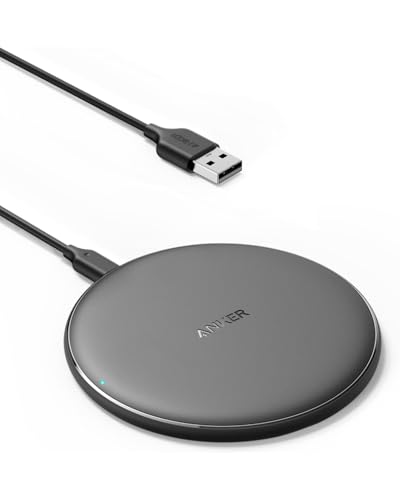
The Anker Advantage: Enjoyed by over 50 million users worldwide, our leading technology will change the way you charge.
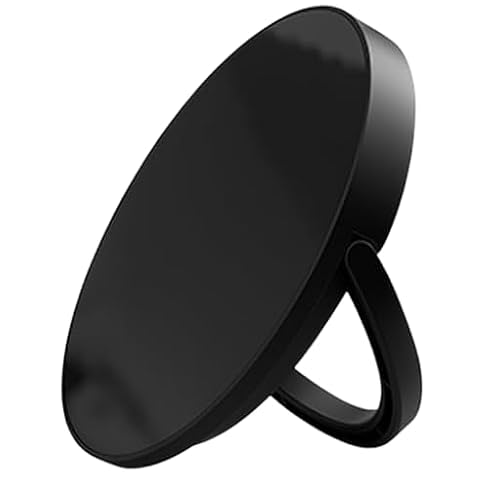
Ultra-Fast Qi Wireless Charging (Up to 15W) - Experience powerful and efficient charging speeds up to 15W for Samsung Galaxy, 7.5W for iPhones, and 5W for standard Qi devices. Just plug the built-in USB-C connector into the cordless charger, snap your device on top, and enjoy quick, reliable charging every time.

【Strong Magnetic Force|360° Auto-alignment】Uses strong magnets for a secure and connection that boosts charging efficiency. You can use this charger without removing your regular case as long as it's less than 2.5mm thick.It's compatible with iPhone 12-17 series. The powerful magnets auto-align your phone to the optimal spot, ditching the need for cables plug-inbond, adjust the angle freely to charging
Mechanisms of Smart Device Detection

Detection of smart devices within Qi chargers relies on a structured process to guarantee efficient charging. Initially, an Analog Ping Phase occurs where the charger assesses potential receivers through test pulses. Next, during the Digital Ping and Identification Phase, longer digital pings are sent to confirm compatibility, with devices responding with signal strength packets.
This identification stage involves thorough data exchanges, which allow the charger to determine the specific capabilities and power needs of each device. Moreover, power transfer adjustments are made by varying the transmission frequency, optimizing charging efficiency. Additionally, foreign object detection (FOD) mechanisms provide safety by distinguishing compliant devices from metallic objects, preventing overheating and potential damage. Advanced charging chips within Qi-certified chargers monitor safe charging conditions continuously, preventing damage from issues like over-voltage and overheating. This extensive approach exemplifies the effectiveness of Qi technology in wireless charging.
Recommended Products

【Strong Magnetic Alignment|Secure & Stable Charging】Equipped with an advanced magnetic array, the charger automatically aligns to the optimal charging position and holds your iPhone firmly in place (✅ no slipping even when shaken). ⚠️ Note: Non-MagSafe cases may weaken magnetic adsorption. For stronger attachment, we recommend using a MagSafe-compatible case.

Up to 10W Wireless Charging: Delivers up to 10W for Samsung Galaxy and 7.5W for iPhone models. Requires a 9V / 2A adapter (not included) for best performance. Charges an iPhone 15 in approximately 3 hours and 47 minutes.

Strong Magnetic Alignment|Secure & Stable Charging: Equipped with an advanced magnetic array, the charger automatically aligns to the optimal charging position and holds your Phone firmly in place (✅ no slipping even when shaken). ⚠️ Note: Be must used with a MagSafe/magnetic case to achieve the magnetic effect For stronger attachment, we recommend using a MagSafe-compatible case
Role of Direct Q Measurement

A significant aspect of guaranteeing efficient wireless charging in Qi chargers is Direct Q Measurement. This method monitors the quality factor (Q) of the coil, which is essential for detecting compatible devices and foreign objects during charging. A lower Q factor indicates interference, which may signal the presence of a foreign object, guiding the charger to adjust its operation, thereby enhancing safety protocols.
Direct Q Measurement increases energy transfer efficiency and minimizes overheating risks by analyzing changes in the coil’s impedance. By identifying whether a device is compatible, Qi wireless charging systems can prevent overcharging and optimize the charging process. This proactive approach guarantees only compliant devices receive power while mitigating potential hazards associated with foreign object presence. Modern 15W wireless chargers incorporate these detection mechanisms alongside built-in safety features like over-voltage and over-current protection to maintain optimal charging temperatures during fast charging sessions.
Understanding the Analog Ping Phase

How does the Analog Ping Phase contribute to the efficiency of Qi chargers? This phase is critical for enabling wireless power delivery without wasting power. While the charger remains idle, it emits test pulses to detect the presence of a power receiver or foreign objects, enhancing foreign object detection (FOD) capabilities. If no receiver is detected, the voltage across the primary coil can reach high levels, such as 60 Vp-p, indicating an idle state.
Detection during the Analog Ping Phase is essential as it allows the charger to prepare for the power transfer phase. Some transmitters rely solely on these test pulses for activation, while others might incorporate additional digital pings for improved identification strategies. Modern chargers with smart charging capabilities can detect device requirements during this phase and adjust power output accordingly, optimizing both efficiency and safety.
The Digital Ping and Identification Process
What takes place during the Digital Ping and Identification Phase greatly impacts the efficiency of Qi chargers. Here, the transmitter emits longer digital ping signals to detect powered receivers, facilitating communication during charging. The receiver responds with signal strength packets, allowing the transmitter to identify compliant devices versus non-compliant objects.
Valid data packets provide essential identification information, confirming the device’s compatibility for power transfer. This phase is instrumental in adjusting transmitted power based on measurements received from the receiver, ensuring efficient charging. Effective load modulation enables the receiver to send necessary information back to the transmitter without interrupting the charging process, optimizing energy delivery and enhancing overall charging performance. Similar to how quick-release mechanisms enable seamless transitions in premium watch bands, the digital ping process allows for swift device identification and adaptation in wireless charging systems.
Foreign Object Detection (FOD) in Qi Chargers
In order to enhance safety during charging, Qi chargers employ Foreign Object Detection (FOD) systems that effectively identify unwanted metal objects on the charging pad. This safety feature prevents overheating by continuously monitoring the pad for potential hazards. FOD mechanisms, such as Direct Q Measurement, assess changes in inductance and capacitance to detect foreign objects accurately.
Qi specifications require FOD systems to balance sensitivity, minimizing false alarms while ensuring efficient charge delivery to compatible devices. Not all metal objects pose a risk, so careful assessment is necessary to distinguish harmless items from potentially hazardous ones. This technology is crucial in advancing wireless charging technologies, promoting safer charging experiences without sacrificing efficiency. Modern Qi power banks incorporate these safety mechanisms alongside features like overcharge protection to safeguard devices during both wired and wireless charging sessions.
Recommended Products
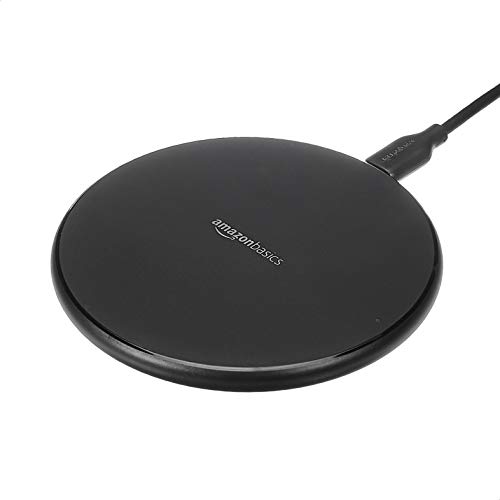
HIGH-SPEED DYNAMIC CHARGING: Enjoy fast and efficient charging with optimized chipsets that deliver 15W for LG, 10W for Samsung, and 7.5W for iPhones using compatible 15W wireless chargers
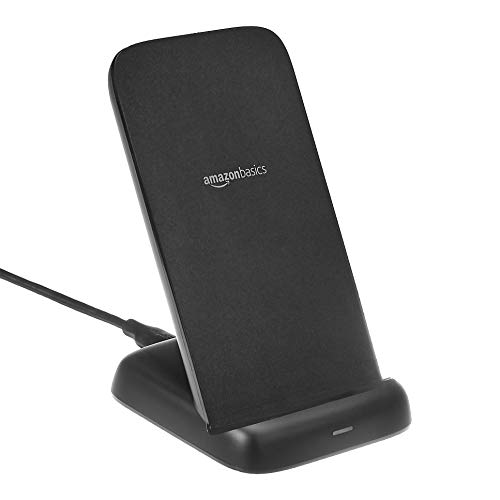
HIGH-SPEED DYNAMIC CHARGING: Optimized chipset provides 10W charging on compatible with LG/Samsung, and 7.5W charging on compatible with iPhones

Two-in-One Convenience: Keep one charger at your desk and one on your nightstand for easy access. No need to move chargers between rooms.
Adjusting Power Levels Based on Detection
The detection of compatible devices on Qi chargers triggers an intelligent response that optimizes the charging process. Qi chargers initiate a digital ping and identification phase, enabling them to determine the type of device present and adjust power levels accordingly. This dynamic adjustment occurs during power transfer, where the receiver modulates its load to communicate real-time measurements with the transmitter.
This process guarantees efficient energy delivery, allowing power levels to vary based on the receiver’s characteristics. Safety protocols, including Foreign Object Detection (FOD), further enhance the system’s reliability by preventing incompatible devices from receiving power. Overall, effective detection leads to maximized charging efficiency while protecting devices from potential damage or overheating. Modern fast wireless chargers incorporate smart chip technology to provide additional protections against overcurrent and overcharging during the power adjustment process.
Recommended Products
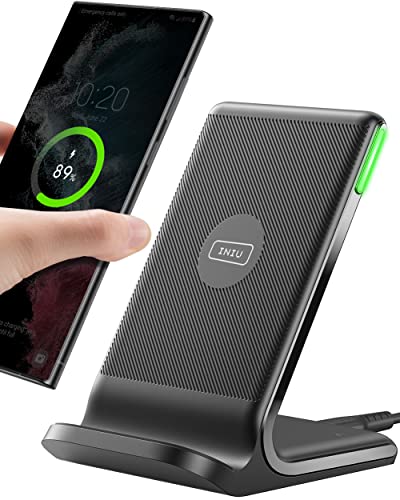
15W Fast Charge for the Morning Rush: Save up to 45 minutes with the INIU Wireless Charger. Powered by AirFuel tech, it’s ideal for commuters needing a rapid power boost before leaving, eliminating the frustration of slow charging.

【Fast Charging 2-Pack for Phones & Earbuds】Supports 25W wireless fast charging with the magnetic compatibility standard. This 2-pack charger efficiently powers your smartphones and earbuds - perfect for home, office, or sharing with family

⚡【Charger Broad Compatibility】The wireless charging pad provides wireless charging for all wireless charger devices. 30W Max Fast Charging,This wireless charger support 5 kinds of output power schemes:30W/15W/10W/7.5W/5W.Different devices will automatically adapt to different output powers,Compatible with iPhone 15/14/13/12/11 series/SE/XR/XS/X/8 Plus, Compatible with Samsung Galaxy S23/S22/S21/S20/S10/S9/S8/7/Buds/Buds Live/Buds2/buds Pro, Note 20/10/9/8/7;and other wireless charger phones.
Enhancing User Experience Through Smart Detection
Enhancing user experience with Qi chargers relies heavily on advanced smart detection techniques that optimize charging processes. These chargers utilize Analog Ping and Digital Ping phases to identify compliant devices, ensuring effective communication between the charger and the device. Smart detection also facilitates foreign object detection (FOD), which prevents damage by identifying metallic objects that could overheat during charging.
Moreover, adaptive power management allows Qi chargers to adjust output dynamically, maximizing charging efficiency according to the receiver’s needs. This thoughtful integration of technology creates a seamless user experience, ensuring reliable performance while reducing risks of overheating or damage. Many modern wireless chargers incorporate magnetic alignment to enhance stability and efficiency during the charging process. Ultimately, smart detection contributes considerably to the effectiveness and safety of wireless power charging.
Recommended Products

COMPACT, WIRELESS QI CHARGER: Cleverly designed with a large yet compact Qi surface area for easy alignment as you charge your iPhone 17, iPhone 16, iPhone 15, Galaxy, and more. A larger pad surface with easy alignment allows stronger charging signal — even with the case on.

【25W Powerful & Secure Wireless Charger】This 25W apple wireless charger with Qi2.2 certification supports 25W fast charging for phones and 5W for earbuds. It charges iPhone 16 to 60% in about 40 minutes with a 16V+ PPS adapter (adapter not included).This wireless charger iPhone has an intelligent chip against overcharge, overcurrent, overvoltage, overheating and short circuit. Efficient heat dissipation and auto power-off ensure safe low-temperature charging and battery protection.

DESIGNED BY APPLE — This MagSafe Charger makes wireless charging fast, easy, and convenient. The perfectly aligned magnets attach to iPhone 12 or later models featuring MagSafe.
Future Developments in Qi Device Detection Technology
Future developments in Qi device detection technology promise significant improvements in the efficiency and safety of wireless charging. Researchers are focusing on enhancing communication protocols, enabling faster and more accurate identification of compatible devices during charging. Additionally, advancements in Foreign Object Detection (FOD) will improve safety by distinguishing between harmful metallic objects and safe non-metallic ones.
The introduction of adaptive charging algorithms is also on the horizon. These algorithms will adjust power delivery based on the type and charging status of devices, optimizing the charging experience. Moreover, integrating machine learning techniques will enhance Qi device detection, allowing chargers to learn from past interactions. Ongoing efforts to standardize Qi2 specifications will promote enhanced alignment and power adjustments across various devices, ensuring a seamless experience. Advanced safety systems like temperature monitoring are already being implemented in modern wireless chargers to prevent overheating and protect devices during the charging process.
Frequently Asked Questions
How to Check Qi Certified Devices?
To check Qi certified devices, one can evaluate the Qi certification process, examine smart device compatibility, inspect safety standards, and test alignment on functional chargers; this guarantees peak charging efficiency and highlights wireless charging benefits for the future of Qi technology.
Is It Okay to Leave Phone on Qi Charger Overnight?
In a world reminiscent of a bygone era, leaving a phone on a Qi charger overnight is generally safe. It promotes battery longevity through efficient charging, minimizes heat generation, and encourages adaptable charging habits within device compatibility limitations.
How Do Qi Wireless Chargers Work?
Qi wireless chargers utilize Qi charging technology through an inductive charging process, employing electromagnetic fields. Proper charging pad placement guarantees device compatibility issues are minimized, optimizing energy transfer efficiency for effective wireless power transmission during the charging process.
What Are the Disadvantages of Qi Charging?
Like a snail’s pace, Qi charging presents disadvantages such as slower charging speed, heat generation risks, compatibility issues increasing costs, potential impact on battery life, and reduced user convenience, which may compromise overall device safety.