As an Amazon Associate, we earn from qualifying purchases. Some links on this site are affiliate links at no extra cost to you. Our recommendations are based on thorough research and editorial judgment.


Safety Certifications for Wireless Chargers: UL, FCC, CE

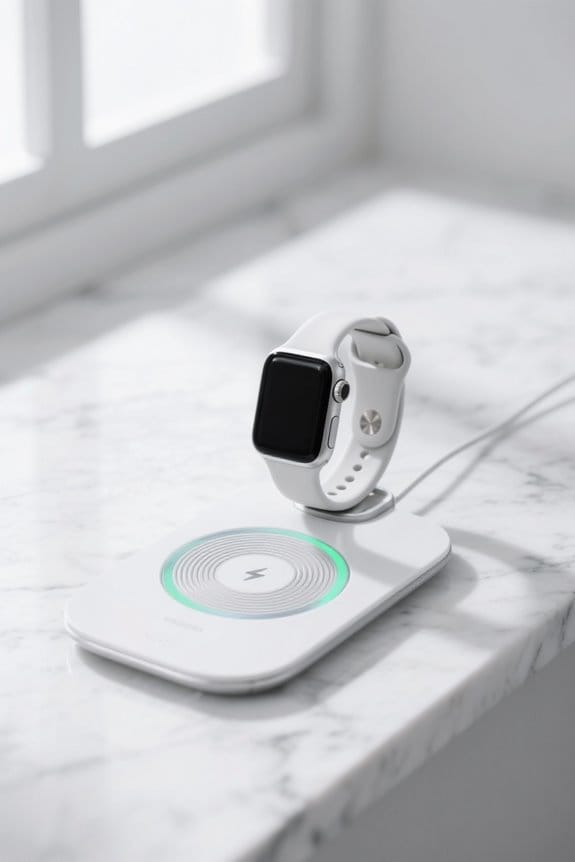
Safety certifications are essential for wireless chargers. They include UL, FCC, and CE, which guarantee compliance with health and safety standards.
- UL Certification: This verifies electrical safety and fire hazards.
- FCC Certification: It confirms that devices meet U.S. electromagnetic emission standards.
- CE Marking: This guarantees compliance with EU health and environmental regulations.
You may be interested


These certifications enhance consumer trust, ensuring that wireless chargers operate safely and effectively. More details can be uncovered on each certification’s significance.
Key Takeaways
- Wireless chargers must have UL certification, ensuring safety through testing for electrical performance and fire hazards as per specific standards.
- FCC certification is crucial for U.S. manufacturers, confirming compliance with radio frequency emissions and preventing interference with other devices.
- The CE mark is essential for selling wireless chargers in Europe, ensuring compliance with EU health, safety, and environmental regulations.
- UL, FCC, and CE certifications help ensure that wireless chargers meet global safety and performance standards for consumer confidence.
- Non-compliance with safety certifications can lead to legal consequences and distribution barriers in various markets.
Importance of Safety Certifications for Wireless Chargers
Safety certifications are critical for wireless chargers, as they help guarantee these devices operate safely and effectively. Certifications like UL, FCC, and CE guarantee compliance with essential health, safety, and electromagnetic compatibility standards. The UL mark indicates rigorous safety testing, confirming that the charger meets Underwriters Laboratories’ requirements. FCC certification is necessary in the U.S., verifying compliance with radio frequency emissions. In Europe, CE certification guarantees adherence to the EU’s health, safety, and environmental directives, granting market access to member states. Manufacturers must secure these certifications to avoid potential product recalls, legal issues, and damage to their reputation, emphasizing the importance of safety in the marketplace for wireless chargers. Compliance with QI certification further reinforces the focus on safety standards. Certified chargers should also incorporate built-in protections against overheating, over-voltage, and short circuits to ensure device safety during charging.
Understanding UL Certification

UL certification plays an essential role in guaranteeing that wireless chargers are safe for consumer use. Conducted by Underwriters Laboratories, this certification verifies that wireless chargers meet specific safety standards related to electrical performance and fire hazards. Products displaying the UL Listing Mark have undergone rigorous testing, confirming compliance with safety requirements.
Wireless chargers must adhere to UL standards such as UL60950-1 and UL62368-1, focusing on low voltage and IT equipment safety. The testing assesses potential risks like electric shock, overheating, and fire, evaluating materials and functionality under normal conditions. These safety certifications protect devices from overcharging and overheating, which is especially important for battery packs and wireless charging accessories. Manufacturers can confirm UL compliance through online directories, offering consumers a reliable method to confirm product safety before purchase, crucial for market entry.
Recommended Products

🌞【Powerful 12000W Off-Grid Inverter – Split Phase 120V/240V Output】The CAMINI 8KW pure sine wave inverter delivers up to 36,000W surge power for 20 seconds. This 48V split-phase inverter converts DC 48V to AC 120V/240V with selectable 50Hz/60Hz. Ideal for off-grid solar systems, home backup, and hybrid power setups, ensuring stable performance for heavy-duty appliances.

AI-POWERED SMART CHARGING & APP CONTROL – This ev charger level 2 uses Autel’s AI-integrated smart app to schedule charging around time-of-use utility rates, helping lower your monthly bill while boosting station utilization. Start or stop sessions remotely, adjust current from low to high amps, view real-time energy data, and get alerts if anything looks off.

3 Wheel folding mobility lightweight suitable for adults over 18 years old, seniors, people with reduced mobility, travel enthusiasts. Kind Reminder: Before use, please check plug in the wire connector and turn the battery to "on". When removing the battery, use the battery key, turn it to "off", then "push" it in and turn it to "unlock" to move the battery. If unknow how to use, send queston and photo back to us, and we'll help
Overview of FCC Certification

To guarantee that wireless chargers operate safely and effectively, obtaining FCC certification is essential for manufacturers in the United States. This certification is mandatory because wireless chargers are classified as devices that emit radio frequency (RF) energy. They fall under FCC Part 15 regulations, specifically categorized as intentional radiators due to their RF emissions.
Compliance with FCC standards guarantees that wireless chargers do not generate harmful electromagnetic interference (EMI) with other electronic devices. The FCC ID is required for wireless charging products featuring data interchange, enabling better tracking and regulation. Obtaining FCC certification necessitates thorough testing for RF emissions and electrical safety, often requiring consultation with accredited testing laboratories to confirm compliance. Many certified chargers also incorporate intelligent protection technology that includes temperature control and surge protection to enhance user safety during operation.
Recommended Products

Smart Bluetooth Monitoring: See voltage, charge level, and health in real-time on the LiTime App. Prevents dead batteries and maximizes performance.

Professional & Building-Wide Coverage - SAMCOM 2 way radios with strong signal penetrates concrete walls and interiors, ensuring reliable communication for commercial and industrial use.

🔋【Automotive Grade Lithium-Phosphate Battery】 asturnu 12.8V 100Ah Group 31 LiFePO4 Lithium Battery is manufactured with automotive grade lithium iron phosphate cells, with higher energy density, more stable performance and greater power. The cells inside the battery are UL tested and FCC, CE certified and IP65 waterproof, providing the highest level of safety.
Significance of CE Marking

For manufacturers seeking to market wireless chargers in Europe, the CE mark represents a vital certification. This mark guarantees that products comply with EU health, safety, and environmental standards, enabling their entry into the European Union market. To obtain the CE mark, manufacturers must maintain technical documentation and may need to self-declare compliance with relevant directives, including safety standards like EN60950-1 and EMC Directive standards such as EN301489-1/3.
Non-compliance can result in product distribution barriers and legal repercussions. Additionally, the CE mark enhances consumer confidence by signifying that wireless charging devices have undergone evaluation for safety and environmental impact. Modern wireless chargers incorporate built-in safety features such as over-voltage and over-current protection to prevent overheating and other hazards during the charging process. This certification ultimately establishes trust between manufacturers and consumers in the competitive European market.
Recommended Products
🚚Ships by truck from California warehouse. For orders placed from August 7th to August 31st 2025, please contact us to get a free spare battery.


INTELLIGENT CHIP PRIMECOMTECH designs its own SMART chargers electronic circuitry-intelligent Chip & software here in the USA, unlike other chargers which dump all the current at once. PRIMECOMTECH EV Chargers communicate with your EV via the data connection port to gather 6 different types of data such as, ambient and battery temperature, EVs current battery level, Battery Capacity, etc. to automatically adjust the voltage to get the longer / most life expectancy from your battery.
Global Compliance and Regional Standards

Compliance with global safety standards is crucial for the successful marketing of wireless chargers across different regions. Wireless chargers must adhere to certifications like UL, FCC, and CE, which guarantee safety and performance. The FCC certification is essential for the U.S. market, focusing on radio frequency emissions compliance under FCC Part 15.
In the European Union, CE certification is necessary, encompassing directives related to electromagnetic compatibility and safety. The UL Listing Mark indicates that the device meets electrical and fire safety standards. Additionally, regional certifications, such as IC in Canada, TELEC in Japan, and KC in South Korea, highlight the global nature of safety compliance for wireless power devices. This guarantees consistent safety across markets.
Many wireless chargers also feature Qi certification, which provides an internationally recognized standard for safe wireless charging technology and compatibility across multiple device manufacturers.
Recommended Products

Smart Bluetooth Monitoring: See voltage, charge level, and health in real-time on the LiTime App. Prevents dead batteries and maximizes performance.

Lithium-Ion Compatible Connect TrueCharge3 battery charger with Lithium, flooded, gel, AGM

HIGH-CAPACITY MULTI-DEVICE CHARGER: 4-Port USB-C PD3.1 charger delivers up to 140W EPR per port (240W total power) to charge 4 laptops/devices simultaneously; Rapidly charges the powerful MacBook Pro 16 (M3 Max/ M4 Pro/Max) from 0 to 50% in just 30 minutes
Frequently Asked Questions
How to Know if a Wireless Charger Is Qi Certified?
With 60% of consumers unaware of Qi certification’s importance, recognizing certification logos on packaging guarantees safe usage. Checking the WPC database confirms compliance with wireless charger standards, benefiting safety awareness and market demand for reliable technology.
What Is a CE and FCC CErtificate?
CE certificates guarantee compliance with EU health and safety standards, while FCC certificates confirm adherence to U.S. regulations. Both certifications promote consumer protection, emphasize wireless technology safety, and facilitate international market access through rigorous certification processes.
How to Get Qi Certified?
To achieve Qi certification, manufacturers must adhere to wireless charger requirements, undergo rigorous testing procedures by certification bodies, guarantee compliance with established standards, and meet quality assurance measures, ultimately gaining market benefits and adhering to industry regulations within defined timelines.
What Is the Difference Between UL and FCC Certification?
UL standards focus on charger safety through rigorous testing methods, ensuring electrical compliance, while FCC regulations emphasize device compatibility and control over radio frequency emissions. Both certifications enhance consumer protection and adhere to critical industry standards.