As an Amazon Associate, we earn from qualifying purchases. Some links on this site are affiliate links at no extra cost to you. Our recommendations are based on thorough research and editorial judgment.


Qi Charging Efficiency Vs Wired Charging

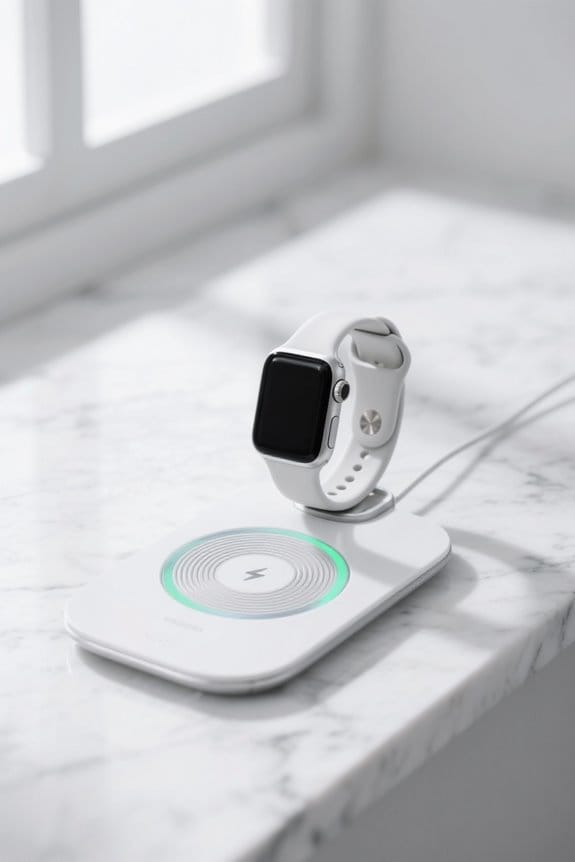
Qi wireless charging can lead to energy losses up to 59%, primarily from electromagnetic induction and misalignment. In comparison, wired charging systems operate at higher efficiencies, typically between 83-94%, with around 35.9% energy loss. Wired charging delivers power directly through a cable, minimizing waste and heat generation. While wireless options offer convenience and reduce wear on device ports, they are less efficient. Understanding these differences can help you make informed charging choices as technology evolves.
Key Takeaways
- Wireless charging (Qi) exhibits energy efficiencies between 41-88%, with average losses around 59% due to misalignment and idle power draw.
- Wired charging systems achieve efficiencies between 83-94%, with approximately 35.9% of energy lost mainly as heat during the charging process.
- Qi charging technology faces greater energy loss, making wired options more efficient for faster charging and reduced waste.
- Idle power draw from wireless chargers can lead to an annual loss of around 5.8kWh, significantly impacting energy consumption.
- The upcoming Qi2 standard aims to improve wireless charging efficiency through better coil alignment, but wired charging remains the more effective option.
Understanding Wireless Charging Technology
You may be interested


While many people are familiar with wired charging, Qi charging technology offers an alternative that utilizes electromagnetic induction. This method employs a transmitting coil that generates an alternating magnetic field, which induces an alternating current in the receiving coil of the device. The typical operating frequency for wireless charging coils hovers between 130-140 kilohertz, optimizing energy transfer.
However, wireless charging technology is not without its challenges. Energy loss during the charging process can reach up to 59%, due to multiple steps of energy conversion and factors like coil misalignment and distance. These inefficiencies highlight the limitations in charging efficiency compared to wired methods, making it essential to understand the trade-offs when choosing a charging solution. Despite these efficiency concerns, modern wireless chargers with fast charging capabilities of at least 7.5W can still fully charge devices in approximately 2 to 2.5 hours.
The Basics of Wired Charging

Wired charging represents a straightforward method for delivering electrical power directly to devices through a physical cable. This process involves a direct power transfer, ensuring a stable and continuous flow of energy to the device. Chargers convert alternating current (AC) from the grid into direct current (DC) for battery use, managed by the On-Board Charger (OBC).
Wired charging is compatible with various devices, utilizing standards such as USB-C, micro-USB, and Lightning connectors. High-quality wired chargers, particularly those using GaN technology, enhance efficiency by minimizing energy loss. Generally, wired charging systems achieve efficiencies between 83-94%, with some energy dissipated as heat during the transfer. In comparison, wireless charging solutions require compatible power adapters of 15W or higher to achieve optimal performance and charging speeds. This technology remains a reliable option for powering consumer electronics across different charging ports.
Efficiency of Wired Charging Systems

Many consumers may not realize that wired charging systems typically operate with an efficiency range of 83-94%. During the charging process, wired chargers convert AC grid power to usable DC for battery consumption via an On-Board Charger (OBC). This conversion, however, carries inherent inefficiencies, with energy lost primarily as heat.
Factors like resistive heating and transformer inefficiencies contribute to waste. On average, approximately 35.9% of energy is lost when charging devices. Over a day, wired charging can draw around 23.6Wh, resulting in an estimated potential waste of 1.94kWh annually. Although GaN (Gallium Nitride) chargers show improved efficiency, traditional charging systems still experience significant energy loss during the charging vs. storage shift. To mitigate these inefficiencies and protect devices from thermal damage, modern chargers incorporate overheat protection and other safety features that help maintain optimal charging temperatures.
Recommended Products

【Immersive 17.3-Inch Full HD Display】Boasting an expansive 17.3-inch Full HD screen, this display delivers ample workspace for seamless multitasking—ideal for managing complex spreadsheets, attending virtual lectures, or streaming your favorite shows. Its larger viewing area boosts productivity for study and work while elevating your entertainment experience.

【2-Year Warranty & U.S. Quality Standards】Enjoy peace of mind with a 2-Year Manufacturer’s Warranty from NIMO Direct Inc. and a 90-Day Hassle-Free Return Policy. Our laptops are partially assembled in the U.S. with rigorously tested global components, ensuring high-standard quality. Plus, our dedicated 24/7 support is always ready to assist you.

【2-Year Warranty and U.S. Quality】Enjoy total peace of mind with a 2-Year Manufacturer Warranty from NIMO and a 90-Day Hassle-Free Return Policy. Our laptops undergo final assembly in the USA using rigorously tested components to ensure premium quality. Our dedicated support team is always ready to assist you whenever you need help, ensuring long-term reliability.
Analyzing Wireless Charging Efficiency

Although wireless charging offers a convenient, cable-free solution for powering devices, it often comes with notable efficiency drawbacks. Wireless chargers generally experience energy losses of around 59% during the energy transfer process, primarily due to the limitations of electromagnetic induction and the alignment of charging coils. In comparison, wired charging achieves efficiencies ranging from 83-94%, indicating a significant gap.
Additionally, wireless chargers consume an average of 0.2W continuously, even when idle, leading to further energy waste. Misalignment between the transmitting and receiving coils also contributes to their less efficient operation. While advancements like the Qi2 standard aim to improve alignment through magnetic rings, wireless charging remains less efficient than traditional wired systems overall. Modern magnetic alignment systems help optimize power transfer by ensuring the charging coils are properly positioned, though they still cannot match the efficiency of wired charging.
Energy Loss Factors in Wireless Charging
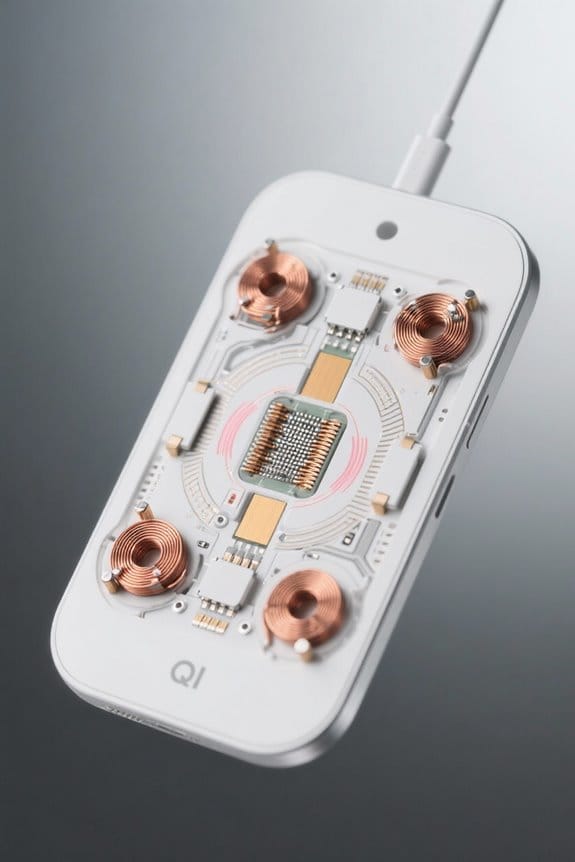
The efficiency of wireless charging is markedly impacted by various energy loss factors that come into play during operation. Misalignment between transmitting and receiving coils is a significant contributor to this energy loss, reducing overall charging efficiency. Qi2 certified devices aim to improve this issue by using magnetic rings to guarantee better coil alignment and decreased energy waste.
Moreover, wireless charging pads continuously draw power, even when not actively charging, with an average idle power draw of approximately 0.2W. This results in substantial cumulative energy loss, which can reach up to 59% for a 12.7Wh battery, highlighting the inefficiencies in comparison to wired options. Such prolonged energy draw can lead to significant annual energy waste, making these factors essential for users to take into account. Similar to how secure connectors ensure proper attachment in wearable devices, proper alignment mechanisms in wireless chargers are critical for maintaining optimal power transfer efficiency.
Comparing Charging Processes: Wired vs. Wireless
How do wired and wireless charging methods compare in their efficiency and effectiveness? Wired charging, utilizing a direct connection, boasts efficiency rates of 83-94%, primarily due to lower energy loss. In contrast, wireless charging pads operate with cumulative energy losses, leading to an efficiency range of 88-93%.
- Energy Loss: Wired charging experiences approximately 35.9% energy loss while wireless charging results in 59% energy loss, showcasing the efficiency gap.
- Charging Speed: Wired charging provides faster charging speeds compared to the slower charging speeds seen with wireless methods, particularly due to potential misalignment issues.
- Safety Considerations: Wireless chargers with Qi certification provide essential safety features like overheating protection and overcharge prevention that help protect device batteries during the charging process.
Recommended Products

Wirelessly charge two devices simultaneously
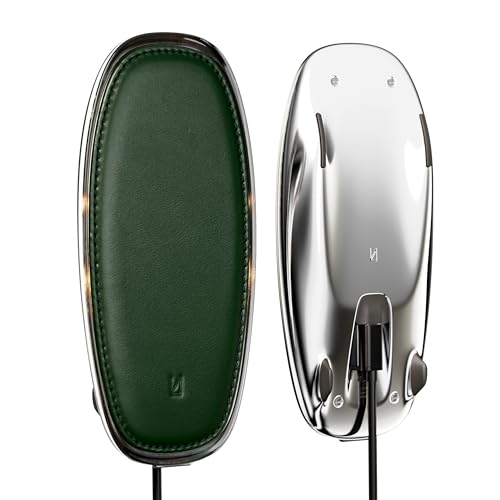
Lunar Artefacts Wireless Charger Lunar Forest Green Leather Chrome Magnetic Charging Pad

3-in-1 Wireless Charging Powerhouse: Base One Max 3 in 1 charging station seamlessly charges your iPhone (up to 15W with MagSafe), Apple Watch, and AirPods simultaneously, keeping all your devices powered up.
Testing Results of Wired Charging
When evaluating the effectiveness of wired charging, specific metrics can provide valuable insights into its performance and energy consumption. A thorough test revealed that charging an iPhone 15 Pro from 0% to 100% consumed 18.25Wh for its 12.7Wh battery, resulting in an energy loss of 5.55Wh, equating to about 35.9% waste. Efficiency during plug-in charging is generally between 83-94%, with energy loss primarily occurring as heat during the charging process. Over a year, this wastage could result in a potential energy waste of approximately 1.94kWh. Utilizing a 65W GaN charger and a 240W USB-C cable helps maintain stability during plugging and unplugging, providing consistent results in these evaluations. Modern chargers incorporate built-in protections against overheating and overcharging to ensure device longevity and minimize energy waste during the charging cycle.
Evaluating Wireless Charging Devices
Evaluating the efficiency of wireless charging devices reveals a mixture of convenience and challenges. Qi wireless charging generally operates at efficiencies between 88% to 93%. However, significant energy losses occur, especially when using chargers like MagSafe, where losses can reach up to 59% for a 12.7Wh battery.
Additionally, wireless chargers continue to draw around 0.2W when idle, leading to increased energy waste over time. Compatibility with Qi2 standards can help improve coil alignment efficiency, addressing misalignment issues that plague many devices. Overall, while wireless charging offers great convenience, it often lags behind wired methods regarding efficiency, making it essential for consumers to weigh the benefits against the costs. When selecting a portable wireless charger, look for models with fast charging capabilities that can deliver 15W to 22.5W output to minimize charging time and improve overall efficiency.
Recommended Products

Iconic Glyph Interface: The iconic Glyph Interface invites you to look at your smartphone less by bringing critical tracking right to the transparent back of Phone (2). From countdown timers and volume indicators to Uber arrivals and food deliveries, glance at the customized LED light sequences to stay informed without ever being sucked into endless screen scrolling

DUAL-ZONE SMART FRIDGE: Keep up to 93L of sodas, wine, and snacks at your fingertips. Features two independent cooling drawers—Left 65L (37-46°F / 3-8°C) for icy drinks, and Right 28L (43-61°F / 6-16°C) for fruits and skincare. Powered by an ultra-quiet 36dB compressor so it won't disturb your TV time

6.7" flexible LTPO AMOLED display, HDR10+ & SGS Low Blue Light, 10-bit color depth, 120Hz refresh rate, 2412x1080px at 394 ppi, 4700mAh Battery, LED Glyph Backdoor
Real-World Performance of Wireless Chargers
While wireless charging provides convenience, its real-world performance reveals notable efficiency challenges. For instance, Apple’s MagSafe charger demonstrated a total energy use of 23.33Wh to fully charge a 12.7Wh battery, indicating a 24.4% increase in energy consumption compared to wired options.
Significantly, the energy loss during wireless charging reached 59%, much higher than the 35.9% observed in wired charging. Misalignment of charging coils adds inefficiencies, with idle power draw losses averaging around 0.2W.
Over time, this can lead to an estimated annual energy waste of 5.8kWh, stressing that wireless power is not just about convenience; it also entails challenges related to heat generated and battery longevity. Standard Qi-enabled devices typically achieve charging speeds of 10W for Samsung Galaxy phones and 7.5W for iPhones, though actual performance varies depending on device compatibility and case materials.
Recommended Products

🌞【Powerful 12000W Off-Grid Inverter – Split Phase 120V/240V Output】The CAMINI 8KW pure sine wave inverter delivers up to 36,000W surge power for 20 seconds. This 48V split-phase inverter converts DC 48V to AC 120V/240V with selectable 50Hz/60Hz. Ideal for off-grid solar systems, home backup, and hybrid power setups, ensuring stable performance for heavy-duty appliances.

【Power Hub For All Your USB-C Devices】From high powered USB-C laptops to tablets and smartphones, Omnicharge can keep all your devices charged up. Compact and functional.also have function of overcharge protection.

Intel Core i3-1220P processor with pre-installed DDR4 8GB RAM, M.2 128G NVMe SSD, WiFi 6E, Thunderbolt4, MicroSD Card Reader, VESA Mount, and Chrome OS
Environmental Impact of Charging Methods
The choice between wireless and wired charging methods carries significant environmental implications. Wireless charging systems, like Qi, are known to waste higher amounts of energy, with estimates indicating up to 59% energy loss. This translates to approximately 5.8 kWh of wasted energy annually for the average user, equating to keeping a 10W LED light on for 24 days.
In contrast, wired charging typically incurs less energy waste at around 35.9%. This decreased energy loss leads to a lesser environmental impact, promoting more efficient energy use. In turn, both charging methods contribute to increased costs for consumers and a higher demand on power resources. Adopting more efficient charging technologies may alleviate some negative effects of wireless charging on the environment. Additionally, heat generation during wireless charging operations is a byproduct of electromagnetic fields that further reduces overall energy efficiency and can impact device battery longevity.
Consumer Considerations for Charging Choices
Considering how charging methods impact both energy efficiency and convenience can greatly influence consumers’ decisions. Wireless charging results in approximately 59% energy loss, while wired charging has only 35.9% waste. However, the convenience of wireless chargers may lead to less wear and tear on device ports, as users can maintain compatible devices in the ideal 25%-85% battery range.
The Qi2 standard introduces magnetic alignment to enhance efficiency, but certified chargers are necessary to utilize this effectively. Consumers should also consider that idle wireless chargers draw an average of 0.2W, prompting awareness of energy consumption. Though wireless charging is less efficient, its aesthetic appeal and convenience continue to attract modern users, balancing energy loss and usability in their charging choices.
Recommended Products
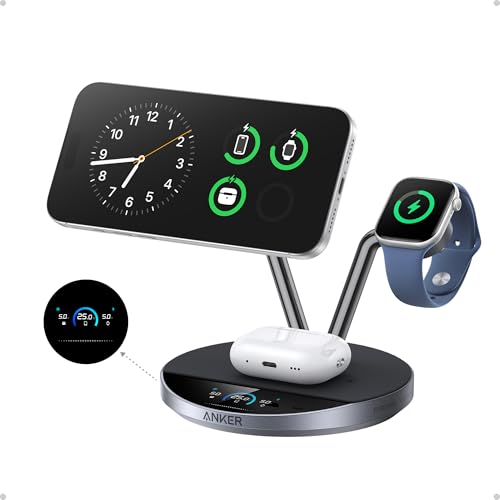
Charge at the Ultra‑Fast Wireless Standard Available: Powered by 25W Qi2.2 ultra-fast charging, your iPhone 17 Pro charges to 50% in just 22 minutes—up to 6× faster than standard 5W wireless chargers. Enjoy the wireless speed you've been waiting for without compromising battery health. Actual performance may vary.

Dual-Action Powerhouse: A powerful magsafe battery and Hi-Fi portable bluetooth wireless speaker in one sleek, pocket-sized device. Enjoy full power, full sound, and ditch the clunky mag safe portable charger & portable speakers bluetooth wireless heavyweights!

Versatile Charging Station: Create your ideal, personalized charging station for multiple devices with the BaseLynx 2.0 modular system. This fast charger station is compatible with Apple iPhone, iPad, Samsung Galaxy, AirPods and other Type-C devices. Includes a 6-ft AC power cable to power the entire system from a single outlet
Future Trends in Charging Technology
As advancements continue to shape the charging landscape, upcoming technologies are set to enhance both efficiency and user experience. The Qi2 standard aims to improve wireless charging by optimizing coil alignment with magnetic rings, considerably reducing energy loss. Research focuses on low-loss resonators and magnetic resonance techniques, aiming to match wired charging efficiency.
Additionally, new methods like resonant charging promise extended distances between transmitters and receivers, although they may introduce potential energy losses. Companies are also exploring integration of wireless charging into everyday environments, promoting seamless user experiences. This shift toward wireless solutions coincides with the growing awareness of efficiency losses, influencing consumer adoption and shaping the future of charging technology.
Frequently Asked Questions
Which Is More Efficient, Wired or Wireless Charging?
Wired charging is generally more efficient than wireless due to lower energy loss and heat generation. It typically offers faster charging speeds and broader device compatibility, making it the preferred choice for ideal energy transfer.
How Efficient Is Qi Charging?
Qi charging boasts impressive charging speed but wrestles with significant energy loss, often generating frustrating heat. Compatibility issues further complicate usage, making efficiency a challenging puzzle as devices attempt to maximize potential amid setbacks.
What Are the Disadvantages of Qi Charging?
The disadvantages of Qi charging include heat generation that may damage batteries, slower charging speed compared to wired alternatives, limited device compatibility restricting use, and ongoing cost factors from energy consumption, even when idle.
How Efficient Is Contactless Charging?
Contactless charging operates with an efficiency range of 78-90%, impacted by energy loss due to alignment issues and varying charging rates. Device compatibility further influences overall performance, affecting the effectiveness of the charging process.