As an Amazon Associate, we earn from qualifying purchases. Some links on this site are affiliate links at no extra cost to you. Our recommendations are based on thorough research and editorial judgment.


How Cooling Fans Improve Wireless Charging Performance

Cooling fans considerably enhance wireless charging performance by ensuring effective heat dissipation. Excessive heat can hinder charging efficiency and damage internal components. Active cooling systems regulate temperatures, preventing power throttling and extending battery lifespan. They optimize energy flow by reducing internal resistance, which improves overall charging reliability. By maintaining cooler temperatures, cooling fans enhance battery health and user satisfaction. Further exploration reveals more about emerging technologies that promise even greater efficiency and safety in wireless charging.
Key Takeaways
- Cooling fans optimize heat dissipation, enhancing charging efficiency during wireless charging sessions.
- Active cooling reduces power loss and minimizes the risk of overheating and interruptions in performance.
- Fans regulate temperatures to ensure consistent power management during demanding tasks like gaming.
- Lower charging temperatures help preserve battery health and extend overall battery lifespan.
- Incorporation of cooling fans promotes device safety by mitigating thermal damage and overheating risks.
Understanding Heat Generation in Wireless Charging
You may be interested


When using wireless chargers, heat generation is a significant factor that affects charging efficiency and device safety. Heat primarily results from electrical resistance in coils, causing energy to convert into heat rather than charging the device. Fast charging speeds, such as 25W, heighten this heat generation, risking performance and safety.
Effective heat management is vital, as prolonged charging can lead to overheating, reducing the lifespan of the battery. Additionally, misalignment between the device and charger can further exacerbate heat production, wasting energy.
To counteract these issues, active cooling solutions, like built-in fans, can dissipate heat effectively. This thermal management not only improves overall charging efficiency but also safeguards device health by maintaining ideal operating temperatures. Advanced systems like ActiveShield 2.0 continuously monitor temperature to prevent overheating and ensure safe charging conditions.
The Risks of Excessive Heat During Charging

Excessive heat during wireless charging poses significant risks that can compromise both charging efficiency and device longevity. High temperatures can increase the internal resistance of power banks, resulting in reduced charging efficiency and longer charging times. Moreover, this heat buildup can lead to temporary power delivery pauses, impacting user experience.
Additionally, overheating can degrade a device’s battery, ultimately shortening its lifespan. It is essential to maintain operational temperatures below 35-40°C to avoid throttling and guarantee peak charging speeds. Safety risks associated with elevated heat include potential battery failures, which may lead to dangerous fire hazards and physical damage to devices. Modern charging stations incorporate multiple protection systems against overheating and voltage spikes to safeguard devices during the charging process. Effective wireless charging solutions should prioritize heat management to mitigate these risks.
Recommended Products
Efficient Multi-Source Charging: Recharge via wall outlet, solar panel, or hand-crank. Achieve 0-100% charge in approximately 3 hours using a PD60W adapter or a solar panel over 100W. (The hand-crank is designed for emergency use only), providing 5 minutes of emergency lighting with just 1 minute of cranking at 2 RPM. While recharging the power station, you can simultaneously charge other devices. This electric generator is perfect for outdoor adventures, home emergencies, and off-grid living, with solar powered generator compatibility for eco-friendly charging. Ideal for off-grid and backup power needs.

FAST CHARGE W/ THE LATEST Qi2 TECHNOLOGY: Conveniently fast charge your iPhone or Qi2 devices up to 25W on the magnetic charger. Fast charging is supported only on iOS 26 and newer, not iOS 18. MagSafe compatible for up to 5x faster wireless charging.*

Intelligent Charging Features Are Designed To Mirror The Movement Of Your Phone, To Ensure A Constant Charge, No Matter The Adventure Or The Placement Of The Phone On The Charger
How Cooling Fans Mitigate Heat Issues

Overheating during wireless charging can lead to performance problems, making effective heat management increasingly important. Cooling technology, like high-speed fans operating at 8,000 RPM, enhances heat dissipation in wireless chargers. By actively reducing heat, these fans improve the charging experience and maintain reliable charging speeds, especially during high-demand tasks.
Additionally, cooling fans help regulate internal temperatures to prevent power throttling, guaranteeing consistent performance. By managing heat efficiently, the risk of overheating is minimized, reducing potential fire hazards and battery degradation. This prolonged lifespan of electronic components guarantees that users enjoy efficient charging without interruptions or safety concerns. Modern wireless power banks incorporate aerogel thermal insulation to complement active cooling systems, ensuring devices remain cool even during extended charging sessions. Overall, active cooling systems are crucial for peak performance in wireless charging technology.
Recommended Products

【Immersive Large-Screen Visual Experience】Featuring a spacious 17.3-inch Full HD display, this laptop provides an expansive workspace that enhances productivity for spreadsheet management, online learning, and multimedia entertainment, delivering crisp details and comfortable viewing.

Bundle Includes: Sony Alpha a6100 APS-C Mirrorless Interchangeable-Lens Camera with 16-50mm Lens, Camera System Gadget Bag with Accessories, 40.5mm 3-Piece UV, CPL, FLD Lens Filter Kit, Battery (2-Pack) and Dual Charger Kit and 64GB SDHC Memory Card

Powerful compatibility: With built-in Godox 2.4G X wireless system, AD600Pro is compatible with Canon E-TTLII, Nikon i-TTL autoflash, Sony, FUJIFILM, Olympus Panasonic and TTL autoflash system.With this AD600 flash, your shooting will become simpler
The Technology Behind Active Cooling

Active cooling systems utilize a combination of advanced technologies to effectively manage heat generated during wireless charging. These systems employ adjustable fans, which improve airflow to enhance heat dissipation and prevent overheating. Operating at high RPMs, often up to 8,000 RPM, the fans considerably exceed the capabilities of passive cooling methods.
Moreover, the integration of temperature sensors enables real-time monitoring of heat levels. This data allows for dynamic adjustments in power output, maintaining ideal charging conditions. Additionally, advanced coil engineering works alongside active cooling systems to reduce energy losses during charging. This synergy not only mitigates heat generation but also boosts overall charging efficiency, ensuring a reliable and effective wireless charging experience.
Comparing Active and Passive Cooling Solutions
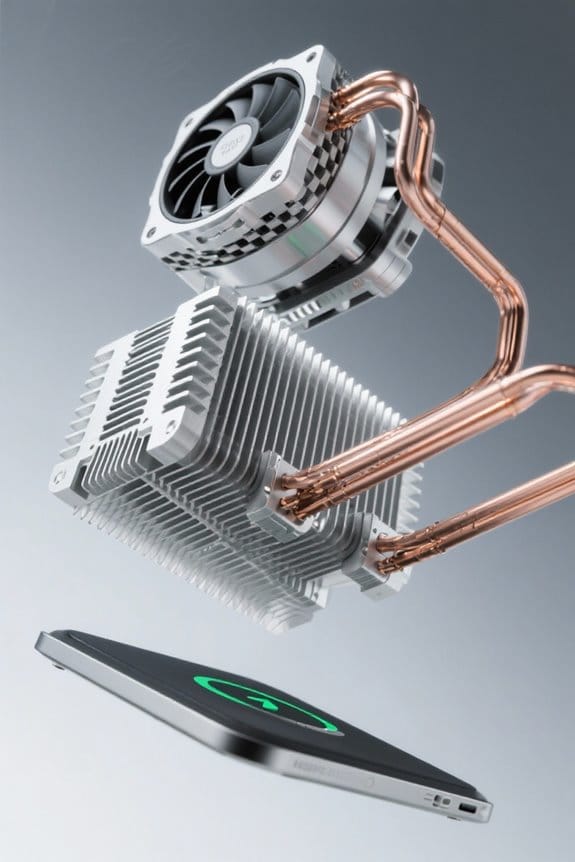
While both active and passive cooling solutions aim to manage heat during wireless charging, their methods and effectiveness differ significantly. Active cooling systems, like those in the SHARGE ICEMAG power bank, utilize mechanical fans to quickly dissipate heat. This allows for real-time adjustments in power output, preventing overheating and maintaining efficient performance.
In contrast, passive cooling depends on materials such as heat-sinking aluminum that disperse heat without active components. Although passive systems are quieter, they may struggle with rapid temperature spikes, leading to gradual efficiency reductions. Many modern wireless chargers incorporate overheating protection as a standard safety feature to prevent damage during extended charging sessions. Overall, active cooling provides superior heat management during high-watt charging, ensuring consistent performance when using technologies like Qi2 chargers.
Recommended Products

SPACE-SAVING SIZE: This bike exercise machine for home boasts compact yet robust dimensions, measuring at 48"L x 25"W x 60"H (350 lb. weight capacity) when assembled. The Sole LCB is the perfect size for an indoor gym or home.

Professional Car Diagnostic Scanner for Technicians & Repair Shops with AI-Assistance: Upgrade of D9S PRO, built for advanced mechanics, workshops and fleet garages that need fast, accurate, and wide-ranging diagnostics. With J2534 programming, ecu coding, AI-assisted full-system topology mapping scan, 4000+ active tests, and 45+ service functions, 20X Faster Wireless, it replaces other auto scanner with one-stop solution. Whether you're handling European, and Asian hybrid vehicles or domestic fleets, XTOOL D9 MAX helps improving efficiency while solving complex repairs, especially for ecu replacement for multiple vehicles, take your automotive diagnostics to the next level

[Market-Leading Hardware Built for Efficiency & Dark Garages] Designed for professionals who can't afford lag, the MUCAR X93 runs on the high-speed Android 10.0 OS and a robust 4-core 2.0GHz processor. Its massive 12600mAh battery supports all-day shop diagnostics without constant plugging in. Built-in LED lights illuminate dark engine bays for clear visibility, while the 10.1-inch (1280*800) sunlight-readable screen and 13MP camera ensure crisp, detailed inspection. Bluetooth 5.1 guarantees a stable wireless connection up to 33ft, completely freeing you from tangled cables.
The Benefits of Cooler Charging Temperatures
Maintaining cooler charging temperatures is essential for improving wireless charging efficiency and battery longevity. Cooler conditions prevent the internal resistance of batteries from increasing, allowing for higher efficiency during wireless charging transfers. This reduction in heat minimization enables faster charging speeds by avoiding throttling when temperatures exceed the ideal range of 35–40°C.
Active cooling systems, such as those equipped with fans, effectively dissipate heat, enhancing the reliability of power delivery and prolonging battery life. Additionally, keeping charging temperatures low mitigates the risk of battery degradation and other heat-related issues. This creates a safer, more efficient charging experience while also reducing energy wastage, thereby maximizing overall charging efficiency for wireless power banks. Modern wireless chargers incorporate advanced heat management technologies alongside other safety features like over-voltage protection to ensure optimal device performance and longevity.
Recommended Products

【Top-Flight Performance 】The 51.2V 100Ah liFePO4 battery is manufactured by 16Pcs Automotive Grade A grade prismatic cells with higher energy density, more stable performance & greater power. And has a compact 5.12kWh energy, which is equivalent to 4pcs 12V 100Ah LiFePO4 batteries in 4S (or even 8pcs 12V 100Ah AGM batteries in 8S). Fully compliant with the UL1973 safety standard and certified by Intertek ETL for reliable safe operation.

Plug/Connector Type: Terminal Block connection for secure hardwired installation
QLED DISPLAY - Stream, browse, and experience gorgeous detail with the magic of QLED which touts virtually 100% color volume and stays vibrant even in direct sunlight
Performance Improvements With Cooling Fans
Cooling fans incorporated into wireless chargers play a crucial role in optimizing charging performance by effectively managing heat. These integrated cooling systems can operate at speeds up to 8,000 RPM, enhancing heat dissipation and maintaining charging efficiency. This active temperature management reduces power loss linked to high temperatures, ensuring that devices continue to draw maximum power during charging sessions.
Furthermore, the presence of a cooling fan prevents excessive internal resistance caused by elevated heat levels, allowing sustained output power. By protecting internal components from overheating, wireless chargers with cooling fans not only enhance performance but also contribute to device longevity. Similar to how durable materials in accessories require proper maintenance to extend their lifespan, wireless chargers benefit from cooling systems that preserve component integrity over time. Ultimately, the inclusion of cooling fans markedly improves the overall user experience, especially during demanding activities like gaming.
Recommended Products

【Immersive Large-Screen Visual Experience】Featuring a spacious 17.3-inch Full HD display, this laptop provides an expansive workspace that enhances productivity for spreadsheet management, online learning, and multimedia entertainment, delivering crisp details and comfortable viewing.

Smart Bluetooth Monitoring: See voltage, charge level, and health in real-time on the LiTime App. Prevents dead batteries and maximizes performance.

Kit Includes 6 Items: All Items come with Manufacturer Supplied Accessories:
Real-World Applications of Cooling Technology
How do cooling fans enhance everyday wireless charging experiences? Cooling fans, such as those in the SHARGE ICEMAG power bank, spin at high speeds to optimize heat dissipation during wireless charging. This technology drastically reduces power loss and improves charging efficiency by maintaining ideal thermal conditions.
In demanding situations, like gaming or video streaming, these active cooling solutions guarantee consistent power management without interruptions. By effectively controlling heat, users can enjoy reliable performance and faster charging speeds, minimizing overheating risks.
Furthermore, the integration of cooling fans by manufacturers not only promotes device safety but also extends the lifespan of both the charger and the battery. Modern wireless chargers incorporate NTC TempGuard technology alongside cooling systems to provide comprehensive overheating protection for devices. This advancement marks a significant step toward guaranteeing user satisfaction in various settings.
Future Trends in Wireless Charging and Cooling Solutions
As the world moves toward faster and more efficient wireless charging, innovative cooling solutions will become vital. Future systems are set to integrate active cooling technologies, such as fans, enhancing thermal management during fast charging. With wireless charging speeds expected to reach up to 25W, effective heat dissipation will be essential for maintaining ideal operating temperatures and protecting battery health.
Advanced materials like graphene and ceramics will likely be adopted, reducing energy loss. In addition, AI-driven thermal management systems will monitor and adjust power outputs in real-time, preventing overheating. Manufacturers may also explore hybrid cooling systems, combining active and passive techniques to enhance performance across diverse charging environments. Similar to how premium silicone materials offer waterproof and sweat-resistant properties in wearable accessories, future wireless charging pads will utilize advanced polymers that enhance heat resistance while maintaining durability.
Frequently Asked Questions
How to Make Wireless Charging More Efficient?
To enhance efficiency in wireless charging technologies, one might employ ideal placement methods, adopt advanced heat management techniques, and refine charging pad design, ultimately elevating power transfer efficiency and ensuring a more reliable energy delivery experience.
How to Increase the Speed of Wireless Charging?
To increase wireless charging speed, one should consider charging pad upgrades, implement battery optimization techniques, utilize heat management solutions, adopt modern wireless charging technologies, and leverage advanced charging protocols for improved efficiency and performance.
Does Cooling Your Phone Make It Charge Faster?
Like a cool breeze on a sweltering day, effective phone thermal management enhances charging efficiency. By implementing charging efficiency tips and leveraging wireless tech advancements, strategies focusing on fan effectiveness can boost battery longevity while reducing heat.
How to Cool Down a Wireless Charger?
To cool down a wireless charger, individuals can explore various wireless charger types, implement cooling fan designs, guarantee ideal placement for airflow, utilize heat dissipation techniques, and follow charger maintenance tips to enhance performance.